
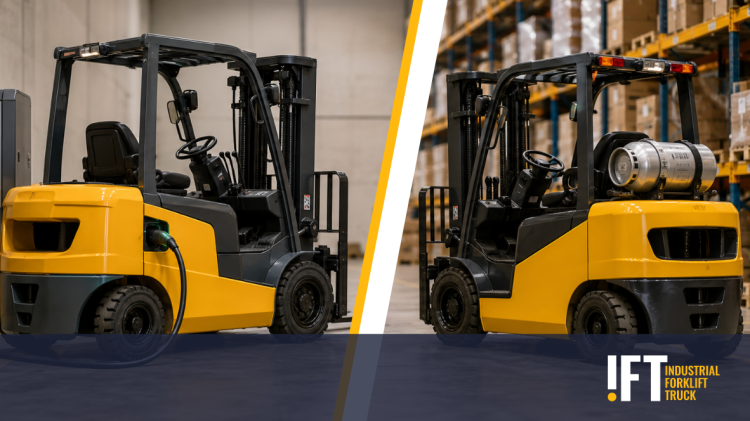
Electric Forklifts vs Propane: The Complete 2026 Comparison
Buying a forklift? Every buyer eventually hits the same fork in the road: electric forklift vs propane? It’s the single biggest decision that shapes how a truck runs and where you can actually use it.
There’s no universally “better” answer here. The right choice depends on your shifts, your facility, and what you’re actually moving. This guide breaks down how each power type works, where each one wins, and how to make the right call for your own operation.
Author note: Gas and diesel forklifts still exist, but for indoor and light-industrial work, the real contest is between electric and propane (LP). That’s where this guide puts most of its weight, covering gas and diesel where they still matter.
Quick Fuel Type Overview
Electric forklifts cost more upfront but less to run day-to-day. They produce zero tailpipe emissions, run quieter, and are the default choice for indoor, single- or double-shift operations.
Propane forklifts cost less upfront, but require ongoing fuel costs. Fuel tanks can be swapped in minutes, allowing LP forklifts to run continuously across multiple shifts without a battery swap. They handle outdoor and mixed indoor/outdoor work better than electrics.
Gasoline and diesel forklifts are mostly an outdoor, heavy-duty niche only used for the toughest outdoor jobs.
How Electric Forklifts Work
Electric forklifts run on rechargeable lead-acid or lithium-ion batteries that power an electric motor instead of a propane engine. There’s no fuel tank, no exhaust, and therefore, no combustion byproducts.
Under OSHA’s forklift classification system, most electric forklifts fall under Class I (electric motor rider trucks) or Class II (electric motor narrow-aisle trucks).
Where electric wins:
- Zero emissions: safe for indoor and enclosed spaces without ventilation requirements
- Noise levels: quieter operation, which matters in shared workspaces or noise-sensitive facilities
- Operating costs: lower cost per hour to operate after the initial purchase price
- Limited maintenance: there are fewer moving parts to maintain
- Cold storage: safe to use in food-grade environments where propane exhaust is a real contamination risk
Where electric struggles:
- Initial costs: a higher upfront purchase price than a comparable propane truck
- Charging requirements: charging takes hours rather than minutes (typically 6-8 hours) for a full charge on lead-acid batteries
- Cooldown requirements: older lead-acid batteries generally need a cooldown period before recharging, limiting how quickly you can top one back up mid-shift
- Add-on costs: running a second or third shift usually means investing in a spare battery and a dedicated charging station
- Performance dips: performance can slow as the battery drains late in a shift
How Propane Forklifts Work
Propane (LP) forklifts run on the same basic principle of a car engine. They burn liquid propane gas in an internal combustion engine, just scaled and configured for lift work. The fuel tank swaps out in about two minutes.
Propane trucks typically fall under OSHA’s Class IV (internal combustion, cushion tire) or Class V (internal combustion, pneumatic tire) categories.
Where propane wins:
- Initial costs: cost less upfront than a comparable electric model
- Fast refueling: refueling that takes minutes instead of hours, which matters if uptime is tight
- the ability for one truck to run multiple shifts back-to-back just by swapping tanks;
- No performance dips: consistent power output that doesn’t fade the way a draining battery does
- Mixed-use cases: perform better outdoors and in mixed indoor/outdoor environments than electric
- Reliable in all climates: propane engines don’t lose efficiency the way lead-acid batteries can in colder climates.
Where propane struggles:
- Emissions: produce carbon monoxide and other combustion byproducts, so indoor use requires adequate ventilation and CO monitoring
- Noise levels: louder than electric
- Maintenance costs: have more moving parts, which means more routine maintenance costs
- Operating costs: ongoing fuel spend adds up over heavy usage, even though propane itself is relatively inexpensive per gallon
Quick Note on Gasoline and Diesel: Where They Still Fit
Diesel forklifts are the choice for the heaviest-duty outdoor work where raw torque and rough-terrain capability matter more than emissions or noise. They’re rarely used indoors because of how much exhaust they produce.
Gasoline forklifts have mostly been phased out in favor of propane, which burns cleaner, is easier and safer to store on-site, and refuels just as fast. You’ll still find gasoline trucks in the used market, but very few dealers sell new gasoline models today. If a listing doesn’t specify, it’s worth confirming which fuel type you’re actually looking at.
Electric Forklifts vs Propane: Head-to-Head
| Category | Electric | Propane | Why |
|---|---|---|---|
| Indoor use | ✓ | ✗ | Zero emissions means no ventilation requirements and no CO exposure to manage. Propane can run indoors, but needs adequate airflow and, depending on local code, monitoring or catalytic converters. |
| Multi-shift operations | ✗ | ✓ | A tank swap takes about two minutes; an electric truck needs either a full recharge cycle or a spare battery and a swap station, both of which cost time, space, and money. |
| Upfront cost | ✗ | ✓ | Propane is typically cheaper to purchase than a comparable electric model, though that gap has been narrowing as lithium-ion battery prices come down. |
| Operating cost over time | ✓ | ✓ | Electric usually wins for single- or double-shift indoor use — tends to be cheaper per hour than propane fuel, with less routine maintenance. Propane wins for heavy multi-shift use once battery rotation and charging infrastructure costs are factored in. |
| Cold storage & food-grade environments | ✓ | ✗ | No combustion exhaust to contaminate product or trip air-quality concerns in freezers and coolers. |
| Outdoor & mixed terrain | ✗ | ✓ | Propane wins for most jobs, with diesel taking over for the heaviest-duty and roughest-terrain work. Consistent power delivery and no cold-weather battery drain both favor combustion engines outdoors. |
| Noise & emissions compliance | ✓ | ✗ | Electric wins on both counts. Worth weighing seriously in a noise-sensitive facility or an area with strict local air-quality rules. |
Maintenance Considerations: What Changes
Electric forklifts have fewer systems that wear out. There’s no engine oil to change, spark plugs to replace, or fuel system to clean.
The main maintenance items are the battery itself, plus the standard wear items like tires, forks, and hydraulics that every forklift shares regardless of power type.
Electric Forklift Maintenance Requirements:
- Watering lead-acid batteries on schedule
- Keeping terminals clean
- Replacing the battery pack
Propane forklifts carry everything an electric truck doesn’t, which requires a more traditional maintenance plan.
Propane Forklift Maintenance Requirements:
- Oil changes
- Replacing air and fuel filters
- Replacing spark plugs
- Engine tune-ups
- Replacing the battery pack
None of this makes propane trucks unreliable; it just means you’ll need to follow a more routine maintenance schedule.
Total Cost of Ownership (TCO)
Looking at purchase price alone is not a fair comparison of an electric vs propane forklift. Instead, look at theTCO, which factors:
- The upfront price difference
- Fuel or electricity cost per operating hour
- Maintenance cost per operating hour
- Battery replacement or engine overhaul costs over the truck’s life
- Downtime costs
These TCO considerations can help you estimate what ownership costs down the line. Plus, how much it costs your operation when a truck isn’t moving product because it’s charging, being serviced, or waiting on a part to be replaced.
As a rule of thumb: the more hours per day and days per week a truck runs, the more the math shifts toward whichever option keeps it moving with the least downtime.
For a single eight-hour shift, that’s usually electric. For two or three shifts back-to-back, that’s usually propane (unless you’re set up with enough spare batteries and charging capacity to keep an electric fleet running without a gap).
Which One Fits Your Operation
Mostly indoor, single-shift warehouse or distribution centers → choose electric. Electric is the default recommendation. Operating costs are lower, there are no ventilation headaches, and they’re quieter for a shared workspace.
Indoor or mixed, multi-shift operations → choose propane. Propane usually makes more sense unless you’re prepared to invest in a multi-battery rotation and the extra charging infrastructure for electric.
Cold storage, food and beverage, or pharma → choose electric. Propane exhaust is a genuine contamination and compliance risk in these vulnerable environments.
Outdoor yards, construction, or rough terrains → choose propane. Propane can work for most jobs; diesel is best for the heaviest-duty and roughest-terrain work.
Budget-constrained purchase, flexible use case → choose propane. Propane’s lower upfront cost makes it the easier first truck for a lot of smaller operations to invest in. The tradeoff is the higher long-run fuel and maintenance spend.
Safety and Compliance Considerations
Carbon monoxide exposure is an OSHA-regulated concern. Running propane equipment indoors requires monitoring CO levels and maintaining adequate ventilation as part of standard workplace safety practice.
Propane tank storage also has its own handling and storage requirements, since tanks need to be stored properly on-site.
Electric forklifts sidestep both of these concerns entirely, which is part of why they’re the near-universal choice for enclosed, tightly-controlled environments like food processing and pharmaceutical warehousing.
That said, electric trucks bring their own handling considerations — battery charging areas need proper ventilation for hydrogen off-gassing on lead-acid systems, and battery changing/watering should follow the manufacturer’s safety procedures.
Frequently Asked Questions
Yes, but with adequate ventilation. Many facilities run propane trucks indoors safely, but it requires attention to airflow and carbon monoxide levels that electric trucks don't need to worry about.
For single- or double-shift indoor operations, electric typically costs less per hour. For multi-shift or heavy-duty use, propane's lower downtime and simpler refueling often win out on total cost.
Most lead-acid batteries run roughly a full shift — commonly cited around 6-8 hours under typical load. Lithium-ion batteries often run longer and charge faster, but they cost more upfront.
Performance can dip slightly in the later part of a charge cycle. This is why multi-shift electric operations need a battery rotation plan, rather than relying on a single battery to last the whole day.
Electric. No combustion exhaust means no air-quality or contamination concerns in freezers, coolers, or food-grade cold storage.
The class numbers describe the power source and tire type together, which is why they're a useful shorthand once you already know whether you want electric or combustion.
Class I covers electric motor rider trucks. Class IV covers propane trucks on cushion tires, typically used indoors and on smooth surfaces.
The Bottom Line
There’s no single right answer for choosing electric forklifts vs propane. The right answer depends on your shifts, building, and budget.
Indoor, single-shift, cold storage, or noise-sensitive operations lean electric.
Multi-shift, outdoor, budget-first, or mixed-environment operations lean propane.
Diesel stays in its own outdoor heavy-duty lane, and gasoline has mostly aged out of the conversation.
If you’re still weighing which forklift class and power type fit your actual workload, see our full breakdown of forklift types for how all seven OSHA classes compare before you buy or rent.